Courses and Workshops
Switzerland
Seminare in der Schweiz 2019
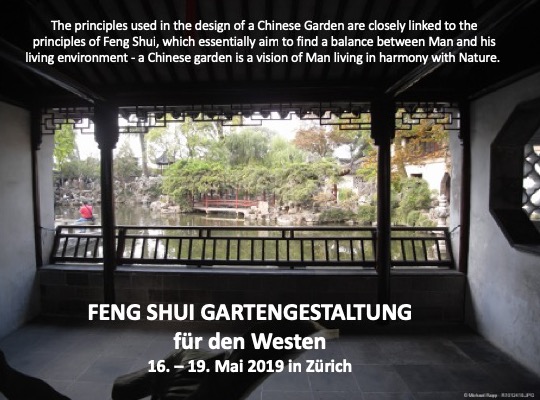
Please click onto the link below to down load a flyer fwith all the details for the workshop.
/www/images/pages/49/Flyer_Garten-Feng%20Shui_ZH_2019.pdf
.........................................................................................................................................Past Events
Residential and Business Feng Shui Consultation –
How to do them efficaciously
A Master-Course Worshop with Howard Choy,
Euorpean College of Feng Shui (ECOFS)
Zurich 17-21 May 2017
This master-course workshop is suitable for practitioners and students who has finished or almost completed their formal training and wish to know more about how to do a Feng Shui consultation systematically and professionally to achieve the result aimed for.
The workshop will begin with some theoretical consideration of how a consultation should be done, especially applied to business and residential feng shui. Some past case studies will be examined in detail to show the theory and the practice of the San Cai Methodology for Feng Shui Audit and Analysis that we have developed in ECOFS.
After learning the theories and looking at some cas studies, we will put what we ave learned in practice, by doing a couple of sample on-site consultations, one related to business and the other to a residence.
By the end of the four-day master-course, the participants should have sufficient skill and know-how to do a consultation on their now effoicaciously to achieve the goals they aimed for to serve their clients.
With this master-course we assumed the potential participants would have some knowledge of the Form and Compass Schools of Feng Shui, in particular the Eight-House and Flying Star School of Feng Shui, but it is not mandatory if you are able to follow the teaching because we will do the practical side step by step in a clear and concise fashion so everyone can learn something useful in this workshop.
We hpe you can join us.
Please click on the image below to download a flyer in German:
Seminare in der Schweiz 2016
風水與貿易通商
Feng Shui and Business
26 - 29 May 2016 Zurich
For the first time, students of business Feng Shui will have a chance to learn advanced techniques of business Feng Shui from a highly experienced Feng Shui architect. This Master Course will focus on how to create the optimum atmosphere for attracting customers and increasing sales revenue.
The workshop will begin with a brief introduction and FS theories to the subject follow by a site visit. In the following days, we will work on the Feng Shui analysis using the San Cai Methodology for Feng Shui analysis developed by ECOFS and discuss its impact on the particular business. Several design approaches and a set of suggestions for improvement for each client will be developed and discussed.
The workshop provides an opportunity to learn from an experienced practitioner and observe up close the intricacies and "craftsmanship" in the application of classical Feng Shui. We will use both the Form and the Compass schools methods, including the Eight Houses and Flying Stars Feng Shui. Some prior knowledge of Feng Shui is recommended but not essential, the aim is to teach how to apply Feng Shui in your work systematically and professionally.
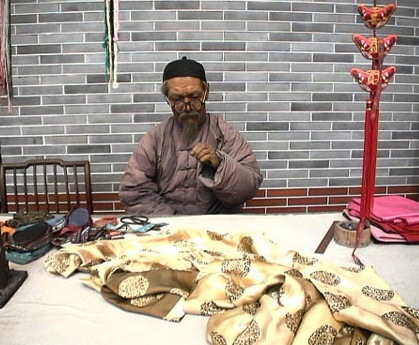
You can download a flyer in German by clicking onto the image of an old Chinese business man (a clothes and fabrics merchant) below:
Past Events
..........................................................................................................................................................................................
Meisterkurs mit Howard Choy: XUAN KONG DA GUA Auswahl günstiger Tage – Februar 2015 in Zürich
Authentisches Feng Shui aus erster Hand
Meisterkurs mit Howard Choy vom 28. Februar bis 1. März 2015 in Zürich
„Xuang Kong Dagua Auswahl günstiger Tage“ ist ein profundes System, um günstige Zeitpunkte zu ermitteln. Das System ist einfach zu verstehen und anzuwenden. Es basiert auf der Idee, den 60 -Jahreszyklus mit den 64 Hexagrammen in Übereinstimmung zu bringen. Mit der Hilfe der Luoshu- Zahlen, der Hetu-Paarungen und der fünf Elementen wird das Zeitgemässe bestimmter Kombinationen im chinesischen Kalender ermittelt.
Im zweitägigen Seminar lernen Sie, günstige Zeitpunkte zu finden und diese in der Praxis anzuwenden. Erweitern Sie Ihre Fachkompetenz und bieten Sie Ihren Kunden künftig gute Daten für Grundstücks- und Hauskauf, Geschäftseröffnung, Vertragsunterzeichnung, Hochzeitstermine, Feng Shui Massnahmen etc. an.
Die Kenntnis des Xuan Kong Da Gua Feng Shui nicht notwendig für den Besuch des Seminars. Hilfreich ist die Kenntnis der Himmelsstämme und Erdzweige, der entsprechenden Zeichen und Elementezuordnungen.
Wir empfehlen den Teilnehmenden sich bereits vor dem Kurs mit den chinesischen Schriftzeichen für die 10 Himmelsstämme und die 12 Erdzweige vertraut zu machen, sowie grundlegende Konzepte des Feng Shui, wie Hetu, Luoshu, früher und später Himmel aufzufrischen. Auf alle diese Themen wird Howard Choy im Verlauf des Seminars nochmals eingehen.
Aufgrund der geringen Gruppengrösse kann Howard Choy auf den Wissensstand und die Fragen der einzelnen Teilnehmenden eingehen.
Wir laden Sie ein zu einem spannenden und praxisnahen Seminar in der angenehmen Atmosphäre einer überschaubaren Studiengruppe (max. 14 Teilnehmende). Der Unterricht erfolgt in Englisch mit deutscher Übersetzung. Für Fragen und Informationen stehen wir gern zur Verfügung.
Im zweitägigen Seminar lernen Sie, günstige Zeitpunkte zu finden und diese in der Praxis anzuwenden. Erweitern Sie Ihre Fachkompetenz und bieten Sie Ihren Kunden künftig gute Daten für Grundstücks- und Hauskauf, Geschäftseröffnung, Vertragsunterzeichnung, Hochzeitstermine, Feng Shui Massnahmen etc. an.
Organisatorisches
Datum: 28. Februar – 01. März 2015
Zeiten: 09.30 – 17.30 Uhr
Ort: Stadt Zürich
Übersetzung: Regula Bielinski
Organisation: Gudrun C. Meier Lange
Seminargebühr: CHF 780.- ab 29. Dezember 2014
(CHF 720.- bei Bezahlung bis 28. Dezember 2014)
Anmeldeschluss: 01. Februar 2015
Anmeldung: mit integriertem Anmeldeabschnitt an Gudrun C. Meier Lange
ORGANISATION + INFORMATION
Gudrun C. Meier-Lange
Blumenau 8, 8184 Bachenbülach/ZH Tel. +41 (0)44 862 08 31
E-Mail: gmeierlange@yahoo.com
Internet: www.meier-lange.ch
Please click image below to download a pdf file on details for the workshop.
Bitte klicken Sie Bild an, um download-Pdf-Datei auf Informationen für die Werkstatt.
XKDG Date Selection is a profound but easily understood and applied system to select an auspicious date. The system is based on the idea of matching the 60 Jiazi to the 64 Hexagrams and then uses the Luoshu numbers and the Hetu pairings with the Five Elements to match the Four Pillars of time to find the timeliness of particular combinations of the 8 characters for time in the Chinese calendar.
In the two-days workshop you will learn the different mutual penetrations (Jiaotong) of how to derive at an auspicious date and also how to apply them in practice.
No special pre-requisite is required and there is not need to know the XKDG Feng Shui system to learn the Date Selection aspect of the system, but it will be helpful if you can recognize the Chinese characters for the 10 Heavenly Stems and the 12 Earthly Branches plus the 8 Trigrams.
...................................................................................................................................................
Past Workshops:
Seminar in der Schweiz 2014
PROFESSIONELLE FENG SHUI-PRAXIS
SEMINAR Die Xuan Kong Da Gua Feng Shui
30 Oktober - 02 November 2014 in Zurich
Zurzeit der Qing Dynastie waren in China sechs verschiedene Xuan Kong Schulen bekannt. Zwei davon blieben bis in die heutige Zeit erhalten: Die heute wohl bekannteste Schule des Xuan Kong Fei Xing (Fliegende Sterne) und die weniger verbreitete Schule des Xuan Kong Da Gua.
Egal ob wir mit dem Landschafts-Feng Shui bei Neubauten und Gärten arbeiten, im Innern des Hauses gute Sterne oder Trigramme aktivieren möchten oder gute Richtungen zum Schlafen oder Arbeiten suchen, mit Xuan Kong Da Gua kann alles berechnet werden.
Xuan Kong Da Gua vereint alle anderen Schulen in sich und gilt als die fortschrittlichste, sehr präzise und wirksame Feng Shui Schule, mit der viele Meister arbeiten. Dieser Meisterkurs bietet Ihnen die einmalige Chance, unter der Führung von Howard Choy eine wesentliche und effiziente Kompass-Methode zu erlernen, welche die Schule der Fliegenden Sterne ergänzt. Zugleich erlaubt sie Ihnen, das theoretische Verständnis des Xuan Kong Feng Shui (Zeit und Raum) zu vertiefen und Ihre Sachkompetenz auf eine höhere Ebene zu führen.
Wir laden Sie ein zu einem spannenden und praxisnahen Seminar in der angenehmen Atmosphäre einer überschaubaren Studiengruppe (max. 14 Teilnehmende). Der Unterricht erfolgt in Englisch mit deutscher Übersetzung. Kursort ist Zürich.
Für weitere Informationen kontaktieren Sie bitte: Gudrun Meier-Lange <gmeierlange@yahoo.com>
Please click image below to download a pdf file on details for the workshop.
Bitte klicken Sie Bild an, um download-Pdf-Datei auf Informationen für die Werkstatt.
PROFESSIONELLE FENG SHUI-PRAXIS
SEMINAR Die San He Wassermethoden
Donnerstag 03. – Sonntag 06. Juli 2014
Die San He Wassermethoden, auch als „San He Pai Feng Shui“ oder „Feng Shui der Landschaft“
bezeichnet, gehören zu den ältesten Methoden des Feng Shui. Da die verschiedenen Methoden
auf der Grundlage gleicher philosophischen Betrachtungsweisen ähnliche Begrifflichkeiten für
verschiedene Techniken verwenden, entsteht grosse Verwirrung. Bis heute stehen keine
verlässlichen Fachbücher zur Verfügung, die die unterschiedlichen Techniken der Wassermethoden
korrekt erläutern. Einige Autoren vermischen die Vorgehensweisen der verschiedenen
Schulen des San He Pai Feng Shui und tragen dadurch zur weiteren Verwirrung bei.
Im Seminar werden die vier wichtigsten Wassermethoden in Theorie und Anwendung vermittelt.
Dabei kommt hauptsächlich der Luopan-Ring der 24 Berge zur Anwendung.
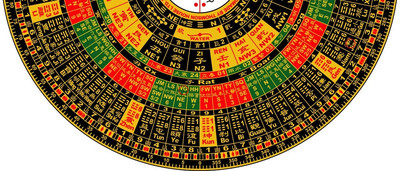
Please click image below to download a pdf file on details for the workshop.
Bitte klicken Sie Bild an, um download-Pdf-Datei auf Informationen für die Werkstatt.
Please note the previous advertised workshop date has changed from
May 15 - 18 to July 03 - 06, 2014.
Bitte beachten Sie, dass Workshop Datum von Mai 15-18 Juli 03-06, 2014 geändert hat.
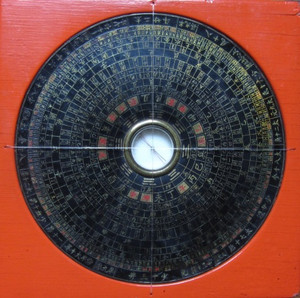
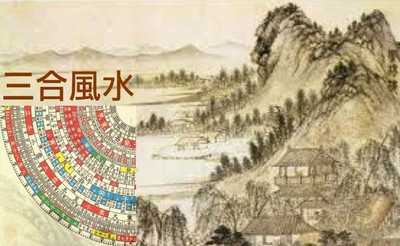
An old San He Luopan given to me by my teacher
Master Ren Zhi-Lin 任志林 from Hong Kong
Seminare in der Schweiz 2013
Professionelles Feng Shui - Seminar FENG SHUI FÜR DAS WOHNEN - in der praktischen Anwendung
Freitag, 30. August – Montag, 2. September 2013
Feng Shui für das Wohnen – bei der Gestaltung eines Hauses oder einer Wohnung als „Zu Hause“ für sich selber, für ein Paar oder für die Familie kommt der Beziehung des Menschen zum Ort, der Atmosphäre eine ganz besondere Bedeutung zu. Feng Shui bietet hier optimale Ansätze und Methoden, auf die Ausgangslage, Wünsche und Bedürfnisse der Bewohnenden einzugehen und für sie geeignete Wohnräume zu gestalten.
Das Sommerseminar 2013 ist einem speziell ausgewählten realen Projektbeispiel im Bereich „Privates Feng Shui“ gewidmet, das über ein angemessenes Mass an Komplexität verfügt. Dies bietet die Möglichkeit, anhand einer konkret vorhandenen Situation verschiedene Systeme und Methoden des Feng Shui in der praktischen Anwendung zusammenzuführen und die eigene Anwendungspraxis professionell zu vertiefen. Es bietet die Gelegenheit an der Seite eines erfahrenen Lehrers die Feinheiten und „handwerklichen Fertigkeiten“ in der Anwendung von Klassischem Feng Shui aus nächster Nähe zu beobachten und zu erlernen.
Zu den zur Anwendung kommenden Methoden und Systemen gehören unter anderem:
Analyse, Ausgangslage und Aufgabenstellung
Feng Shui Paradigma und San Cai Methodologie
Geschichte des Ortes
Aspekte der Formschule
Facing und Sitting
Bazhai (Zhai Gua und Ming Gua)
Fliegende Sterne
Für weitere Informationen kontaktieren Sie bitte: Gudrun Meier-Lange <gmeierlange@yahoo.com>
Klicken Sie hier für weitere Informationen
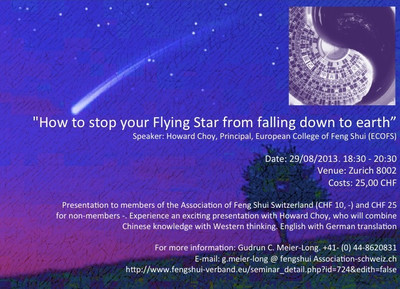
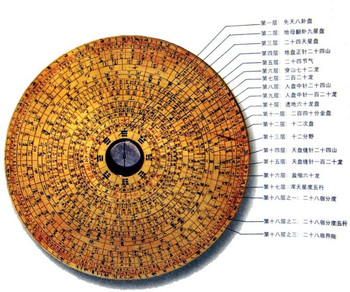
Professionelles Feng Shui - Seminar
„DIE PRAKTISCHE ANWENDUNG DES SYSTEMS DER FLIEGENDEN STERNE “
Freitag, 01. März – Montag, 04. März 2013
Bitte klicken Sie auf das Bild Luopan für Details
Die Fliegenden Sterne (Xuan Kong Fei Xing) sind eine Methode der Kompass-Schule des Feng Shui, welche die Zeitkomponente ins Spiel bringt und die Wechselwirkung zwischen Gebäude- struktur und Umgebung, zwischen Innen und Aussen betrachtet. Es ist ein abstraktes System, das ein „Gegenstück“ zur Form-Schule bildet, die mehr die greifbaren physischen Gegebenheiten im Blickfeld hat.
Das System ermöglicht, die Zyklen des Schicksals eines Gebäudes im Zusammenhang von Zeit und Raum zu ermitteln, um geeignete Orte und Strukturen zu finden und Harmonisierung und Verstärkung der Energien in Räumen zu erreichen. Die Ergebnisse können in die architektoni- sche Planung eines Hauses oder in die Umstrukturierung, Neugestaltung und Einrichtung von Innenräumen einfliessen. Es ist ein sehr hilfreiches Werkzeug zur Festlegung von Gebäudeeck- daten wie Ausrichtung, Lage des Eingangsbereiches, Anordnung von Räumen, Bewegungs- zonen, Treppen usw.
Für weitere Informationen kontaktieren Sie bitte: Gudrun Meier-Lange <gmeierlange@yahoo.com>
Seminare in der Schweiz 2012
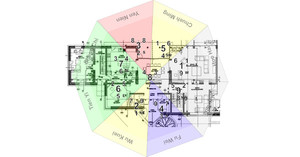
FEMNG SHUI - FLIEGENDE STERNE ADVANCED
Zurich, 4. Mai - 7. Mai, 2012
Klicke auf die Grafik um die Datei herunterzuladen
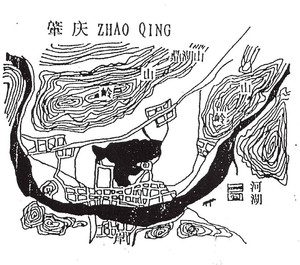
FENG SHUI - FORMSCHULE ADVANCED
Zurich, 31. August - 03. September, 2012
Klicke auf die Grafik um die Datei herunterzuladen
Seminare in der Schweiz 2011
FENG SHUI - GARTENSEMINAR
Zürich, 26. August – 29. August 2011
Gartengestaltung im alten China
In China entwickelte sich die Kunst des Gartendesigns vor etwa 3000 Jahren in den königlichen Parks. Später fand sie auch Eingang in die kleineren Privatgärten der Reichen und Mächtigen des Landes. Während der Blütezeit der Gartengestaltung (Ming-Dynastie) verstand man Gärten als Rückzugsorte der gehobenen Gesellschaft von der städtischen Umgebung und von den Zwängen des bürgerlichen Lebens. Das Prinzip der chinesischen Gartengestaltung ist eng mit der chinesischen Sicht auf die (Um)Welt verbunden, in der es um die ausgewogene Balancierung von polaren Kräften geht, ausgedrückt durch Yin und Yang.
Die Prinzipien der chinesischen Gartengestaltung sind ein wichtiger Teil des kulturellen Erbes Chinas. Sie stehen für die selbstverständliche und natürliche Gestaltung von Räumen und Anlagen, die zwar von Menschen geschaffen sind, aber natürlich wirken und selbstverständlich erscheinen. Sie leiten durch die Landschaft ohne zu führen, sind im Grossen überschaubar und im Kleinen grosszügig. Es sind Räume mit einer einmaligen Atmosphäre, einem Wechselspiel zwischen Aufgehobensein und Überraschung, Enge und Weite, Offenheit und Begrenzung - Yin und Yang. Die chinesischen Gartengestalter waren Meister in der subtilen Manipulation des Raumes.
Die wichtigsten Prinzipien der chinesischen Gartengestaltung:
· Meister und Gefolge
· Konstante und Veränderungen
· Ruhe und Bewegung
· Gegenüberliegender Blick und geborgter Blick
· Flachheit und Tiefe
· Gegenstand und Leere
· Das Zusammenkommen von Raum und Zeit, Innen und Außen, Form und Atmosphäre in Räumen und Landschaften
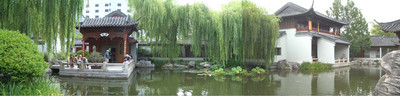
By Clicking HERE you can download a pdf File of the Feng
Shui and Traditional Garden Wokshop in Zurich 26-29 August 2011
Feng Shui and Traditional Chinese Gardens
By Howard Choy (Cai Hong), Feng Shui Architect.
Many people think Feng Shui and Chinese Gardens do not have much in common, but that is not true because they shared a common objective and that is to respect nature and re-create nature in such a way that the objectivity of a “view” (“jing”) is connected to the subjectivity of an “affection” (“qing”), so we can create a man-made environment that is as though it is made by nature herself and we can relate to it and feel “loved” by it. There is no need to be neither vulgar nor try to be clever, a good Chinese Garden is like a good Feng Shui house, it is holistic, simple and pure (“qing tan”).
Holistic in the sense that the various components of a house or a garden do not stand on their own, they associated with each other and affect each other instead. They are the result of coming together of various contradictions.
Simple and pure in the sense that the device used to make a house or a garden is the result of looking for harmony and balance in the yin and yang forces of nature, it is not over or underdone, it is just self-thus (“ziran”). In order to do this, we need to observe and study a site not only from one point of view, but also from all directions both looking in and looking out, physically and metaphorically speaking.
Before the planning stage, we observed what is near and what is far, what is assembled and what is dispersed, what is substantial and what is insubstantial, what is broken and what is continuous, etc. so we can understand how the yin and yang forces support and influence each other, or to use a Chinese term, we seek the “ben xing” or the “original character” of a site, before we start to design, otherwise we will not be able to obtain “the spirit of the mountains and valleys” in a simple and direct way in our work.
So the Feng Shui way to create a Chinese Garden is first learn from nature and there is a pattern to her formation. By learning from nature we can recreate the beauty of nature, but first we must understanding what is meant by “beauty” from a Chinese perspective:
1) Beauty is rest in the form and the spirit. We observe objects through our senses with the eyes being the most acute. The eyes determine our directions and we can differentiate the “spirit” (“shen”) of an object through the observation of its “form” (“xing”). Only by catching the spirit that we can catch the basic characteristics and the beauty of an object. The relationship between “form” and “spirit” or “xing” and “shen” is one of the crucial topics of traditional Chinese aesthetics. Here are some Chinese sayings concerning form and spirit to help us understand more of their relationship: “Have both form and spirit”, “Use form to write the spirit”, “Create the form to pass on the spirit”, “Form is easy to achieve, spirit is difficult to obtain”.
2) Beauty rests in the artistic conception of the place (body) and mind (perception). To the Chinese, an artistic conception is the product of the integration of the objective “views” with the subjective “feelings”. A Feng Shui garden should feel alive, healthy and contagiously delightful and there is the delight of the mind, delight of the spirit, delight of the form and the simple delight of feeling alive while walking through the place.
3) Beauty has a constant principle (“cheng li”) and it can be found in the regular patterns of the landscape. If we can thoroughly investigate what is visible in nature, then we can proceed to recreate her beauty. Su Tong-Po, a famous Chinese poet said once, “Mountains and rocks, bamboos and trees, waves and rocks, although they don’t have a regular shape, they have a constant principle”. The core idea behind Feng Shui architecture and garden is to abide by the constant principles, then recreate them in various forms to transmit the spirits.
Therefore in the Chinese theory of beauty, there is a tripartite relationship between Li (Principles), Qu (Delights) and Fa (Methods). Li is to understand the constant unchanging principles of nature, Qu is to understand the endless changes and the rhythms of life and Fa is to combine the two to reflect them in the form of our creations. Having the methods but no principles – not it and having the principles but no delights – again not it.
To the Chinese, true beauty has the form and the spirit that are the result of having the principles and delights in the methods. A good garden layout should know the limitations of a site and express its advantages. The layout should follow what is naturally there and we should study the environment thoroughly before we come to a solution that fits in with the context of the site and the needs of our clients and their budget.
In the coming Feng Shui and Chinese Garden workshop in Zurich from 126-29 August 2011, we will investigate these traditional methods and techniques used in a Chinese garden. The aim is not to make a Chinese looking garden, but a comp temporary garden that has the spirit of a tradition. No prior Feng Shui knowledge is required, as we will teach the creative techniques of the art of a Chinese garden step by step, culminating in using the theories we have learned and apply them in practice, by planning a garden on a real site with a real client.
All are welcome, please come and join us!